
Good Debt vs Bad Debt
- Kul Deep
- Updated May 8, 2026
Debt is a financial tool to help you manage your financial shortcomings and achieve other goals. Debt can be beneficial when used wisely, but it can put you in significant economic problems when used poorly. It is generally seen that when an individual is in dire need of money, they turn to a bank, a financial institution, or a credit card for a loan or debt. Now the question arises, for what purpose is the loan being taken? The purpose of taking a loan determines whether a debt is good or bad.
Yes, it is absolutely true that an Individual’s purpose of taking debt can clear the fundamental issue. We know debt is used to fulfill various tasks, some essential and some non-essential. Debt used for essential work is considered good debt, while debt used for non-essential work is considered bad debt. In this article, we focus on analyzing how both types of debt can impact your life, the kinds of situations you may encounter after using them, and ways to avoid bad debt.
Key Takeaways
- Good debt is borrowing for investments that will increase in value or generate income in the future, like a student loan, a business loan, or a mortgage.
- Bad debt is borrowing for non-essential assets at high interest rates, which can lead to financial stress and damage your credit score.
- Managing debt wisely means evaluating interest rates, increasing income, saving for emergencies, and borrowing for the right reasons to stay financially healthy.
- Knowing the difference between good debt and bad debt will help you make informed financial decisions that support your long-term goals and avoid debt overload.
What is a Good Debt?
Good debt is debt that can help you grow your financial approach. This helps you eradicate all your financial hardships and makes life smooth and stress-free. The thing that makes any debt a “good debt” is the positive, value-creating approach that recognizes the ability to generate long-term benefits from that debt. There are many sectors in which debt can be used effectively to build wealth and drive financial growth.
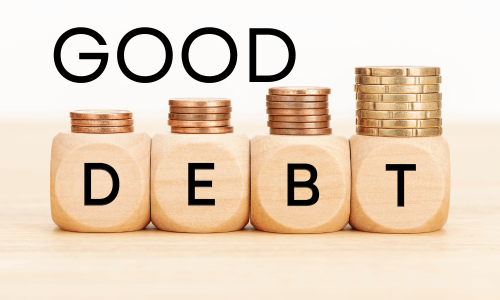
Examples of Good Debt
Debt for Education:
Education is an investment in itself. This is a light that can lead you to the heights of success and a bright future. Investment in education is one of the most common examples of good loans. Education loans, when used properly, can lead to greater career opportunities. This type of loan enables students to earn a living and enjoy a better future.
Debt For Business:
A business loan can be considered a good loan. Generally, businesses require loans to expand. This loan allows them to build a long-term business on one side and also helps them manage financial crises in business from time to time on the other side.
Debt For Real Estate:
When you buy a home or invest money in real estate property, using a mortgage can also help you to build wealth over time. This is a kind of forced, risky saving that will benefit you, as the price you have paid today will not be the same in the future. The same property or house will go on increasing in price multiple times. For example, in Houston, Texas, where real estate is fast-growing, applying for installment loans with us is easy and can be a valuable move. This is also called good debt, which you can use to buy real estate and help you build equity.
Low-Interest Rate Debt:
Definitely, low-interest-rate debt plays a significant role in improving your financial situation. If you buy a car or home on a low-interest loan, this will be very affordable and less of a financial burden. This loan will not only help to build equity but also prove to be a blessing for you.
Tax Advantage and Long-Term Perspectives:
Some types of good debts offer you a tax rebate. With this allowance, your overall liability to repay the loan is reduced. As we know, good debts are taken to keep long-term goals in mind, and this may take time to bear fruit and yield a good financial future.
FACT
Good debt typically has lower interest rates compared to bad debt.
What is a Bad Debt?
Bad debt refers to money borrowed to address various financial hurdles that cannot be repaid due to factors such as mismanagement, overspending, or unexpected expenses. Bad debt also occurs when taking on a loan for unnecessary purposes, which can lead to further financial uncertainty. Thus, bad debt can have a severe impact on your business life, home budget, and other decisions you are going to take in your future life. Here are some key factors that can be counted among bad credit.
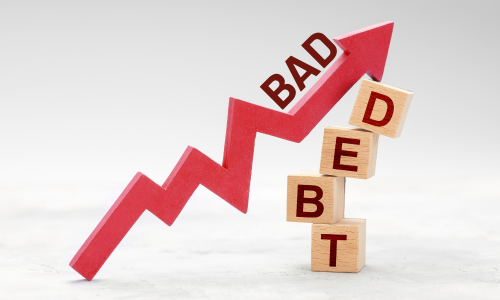
Examples of Bad Debt
Credit Card Debt With High Interest:
When discussing bad debt, credit card debt with high interest can be considered bad debt. Using credit cards to enjoy luxury shopping and spend money without considering their impact on your upcoming financial future can lead to sudden money trouble and damage your credit score as well. This cycle of debt sometimes does not break and ends with bankruptcy. So you need to be aware of it and find ways to avoid credit card debt in any situation.
Payday Loans:
Payday loans also come with exorbitant interest rates. These types of loans allow you to collect instant money but also require you to pay it back in a short period of time at a high interest rate. This also creates a cycle of debt in which an individual feels to be trapped. This should be considered a bad debt, and avoiding such loans can make your financial life smoother.
Consumer Debt:
This debt you take when you do not have money to spend to enjoy vacations, or holidays, and buy some expensive non-essential products for which you don’t have any type of requirement in your life. Spending money on futile things by taking such bad loans is never considered a valuable decision.
Taking Debt To Buy Depreciating Assets:
Buying assets with loans that will decrease their value in the future is not a good decision. Auto loans, car loans, etc., can be considered unnecessary loans. You should avoid these loans as much as you can. Never buy things that do not have the potential to increase in value over time.
FACT
Automobile loans are generally considered bad debt because vehicles depreciate quickly.
How To Avoid Bad Debt?
Evaluate Interest Rates:
Generally, any debt is considered bad if it carries a high interest rate. Debt with high interest rates is impossible to repay, and it can leave you stuck in a cycle of debt. Before taking any type of debt, it should be your prime concern to analyze the interest rate. You should also avoid buying unnecessary products with high-interest loans, so you do not achieve your financial goals.
Increase Your Income:
Loans are the best financial tools that help you to come out of difficult financial situations. But if we analyze, a loan is needed when we do not manage our money properly or have limited financial resources. With increased income, all debt-related problems can be solved. If you increase your sources of income, you do not need to take on a debt that is impossible to repay.
Save For Rainy Days:
Emergency funds to assist you during hard days are the best possible way to adopt. Your savings can help you avoid taking on debt and maintain your financial position. Using your own saved money instead of borrowing at high interest rates can be a much more intelligent decision.
Choose Debt For the Right Purpose:
Borrowing money is not always a bad decision, but taking it for the right purpose makes a difference. When applying for a loan or debt, interest rates and loan terms should be carefully evaluated. All the terms and conditions should be clear to you, and such a loan should be used to fulfill beneficial purposes that can return you with an advantage.
The Bottom Line
Both good debt and bad debt fulfill the need for money in a tight spot, but the ways they are used differ. While good debt can help you build your future by investing in the right direction, bad debt comes at a higher interest rate and, without investing in the right direction, is spent on unnecessary activities, ruining your financial situation. Therefore, a loan is the right one that can turn the difficult time of your life into an easy one, and that too without giving any burden.
Frequently Asked Questions
Is a car loan good debt or bad debt?
It really depends on your situation. Taking out a car loan for a basic vehicle you need to get to work can be a reasonable debt. On the other hand, a high-interest loan for a luxury car that quickly loses value is usually considered bad debt. The main thing to ask yourself is: do I truly need this, and can I comfortably afford the payments?
Can a good debt turn into a bad debt?
Yes, definitely. Even good debt can turn into bad debt if you borrow more than you can afford to repay, choose a loan with a very high interest rate, or if your investment does not go as planned. For instance, a home loan can become a problem if your monthly payments exceed your income.
Are installment loans good or bad debt?
Installment loans, such as personal loans or auto loans, can be a smart way to borrow if you use them responsibly. With fixed monthly payments and a set payoff date, they are often easier to manage than credit card debt. They can also help you combine high-interest credit card balances into one lower, fixed payment.
